

24 Sep Portfolio rebalancing at scale: How financial institutions combine agility and compliance
When trades lag, compliance exposure rises. When processes stall, client confidence weakens. At institutional scale, these aren’t minor inefficiencies; they are liabilities.
On paper, rebalancing sounds simple: bring portfolios back to target allocations. Wealth managers today still struggle to automate rebalancing because every client portfolio has a unique mix of tax quirks, legacy positions, and one-off constraints that break clean, rules-based logic, further complicated by the continued prevalence of often clunky legacy technology systems and heavy compliance oversight.
“Rebalancing used to be something you did quarterly. Now it’s something you need to be ready to do every day across thousands of accounts without breaking compliance. That shift changes everything”, said Mathieu Mormont, Product Leader at Croesus.
As a result, many firms still rely on manual workflows, spreadsheets, and after-the-fact oversight approaches that may work for dozens of accounts but break across thousands. Advisors and operations teams end up working through spreadsheets and exceptions one account at a time. Policies are interpreted inconsistently. Trades are delayed. Audit trails become fragmented. Portfolios drift.
Meanwhile, markets move faster, regulations grow more complex, and investors expect portfolios tailored to their specific tax profiles, constraints, and goals in near real time. What was once quarterly maintenance is now a daily strategic capability directly tied to performance, risk management, and retention. What starts as an operational nuisance becomes a firm-wide risk.
At a time when margins are tightening and scrutiny is rising, inconsistency is expensive.
Rebalancing is now a strategic lever
Vanguard’s Advisor’s Alpha research confirms what many firms already suspect: disciplined rebalancing isn’t just maintenance; it can improve outcomes.
Key findings:
- Disciplined rebalancing is a measurable contributor to the advisor’s results, not just housekeeping.
- Emotion-free, rules-based execution is what captures that value.
- Applied systematically, it limits the allocation drift that quietly introduces unintended risk and keeps portfolios aligned to the client’s intended risk level.
The takeaway is simple: rules-based discipline improves results. But applying that discipline across thousands of portfolios manually is nearly impossible. Technology becomes the enabler.
Scale requires automation, not more people
Adding headcount doesn’t solve scaling problems. It just adds complexity. Automation fundamentally changes the equation.
Modern rebalancing engines can:
- Evaluate thousands of accounts simultaneously.
- Apply investment policy constraints consistently.
- Optimize trades.
- Generate documentation automatically.
- Maintain full audit trails.
All in minutes rather than days or weeks. Compliance is embedded in the process rather than checked after the fact.
“Automation isn’t about speed alone. It’s about consistency. Consistency is what reduces risk,” said Mormont.
Client expectations are rising fast
According to EY’s Global Wealth Research Report, operational pressure isn’t the only force driving change. Client behavior is evolving too. Investors expect more personalization, faster adjustments, and digital sophistication. Firms that can’t deliver risk losing assets.
Highlights:
- Nearly 50% of wealth clients plan to move a significant portion of their assets over the next 1 to 3 years.
- Clients cite quality of advice, personalization, and digital experience as top drivers of provider choice.
- Firms must modernize operations and technology to retain and grow assets.
In other words, portfolios must adapt quickly and visibly to clients’ needs. Static or slow processes create churn risk. Manual rebalancing simply cannot support that expectation.
Hyper-personalization is the new baseline
For years, the industry relied on broad categories like conservative, moderate, and aggressive. But today, two investors with the same risk tolerance may require very different portfolios due to taxes, restrictions, or account structures.
That’s where traditional approaches break down, as identified in last year’s Capgemini report.
Key themes:
- Technology-enabled hyper-personalization is now a competitive necessity.
- Firms investing in automation and digital platforms achieve greater scalability and operational efficiency.
- Leading wealth managers are embedding advanced tools to deliver customized portfolios at scale.
Personalization and operational efficiency must happen simultaneously, not sequentially. That’s only possible with intelligent automation.
Delivering personalization at scale
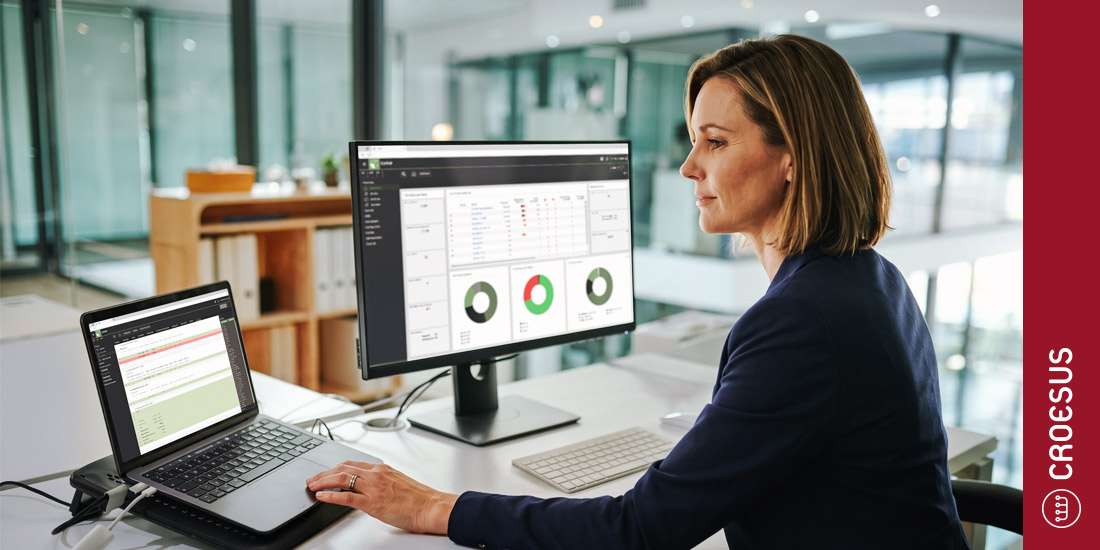
Solutions like Croesus Central were built specifically to address this gap.
Rather than forcing clients into a handful of model buckets, Croesus Central enables automatic rebalancing across thousands of portfolios while respecting a wide range of constraints for every investor, including tax profiles, investment policies, exclusions, and account-specific rules.
Each rebalance becomes:
- Consistent
- Compliant
- Auditable
- Hyper-personalized
The firm doesn’t have to choose between customization and scalability. It gets both.
“Clients want a portfolio that feels built for them. That doesn’t mean abandoning models; it means personalizing on top of them, and technology is what makes that possible at scale,” said Mormont.
Agility becomes a competitive advantage
When markets move or regulations change, firms must respond quickly. Manual cycles take weeks. Automated systems take minutes.
That difference isn’t operational; it’s strategic. It determines who protects performance, who maintains compliance, and who keeps client trust. Increasingly, agility itself is the differentiator.
Action checklist: Is your rebalancing process built for scale?
Ask yourself:
- Can we rebalance thousands of portfolios simultaneously?
- Are constraints and policies automatically enforced for every account?
- Do we have clean audit trails for regulators at any time?
- How fast can we react to market or regulatory change, minutes or weeks?
- Are portfolios truly personalized or grouped into broad models?
- Are advisors advising or managing spreadsheets?
If these questions expose friction, delays, or inconsistencies, your infrastructure may be limiting your growth. Modern automated platforms like Croesus Central enable firms to combine discipline, compliance, personalization, and scale, all at once. Because today, rebalancing isn’t just about adjusting allocations.
It’s about protecting outcomes, reputation, and competitive position.